
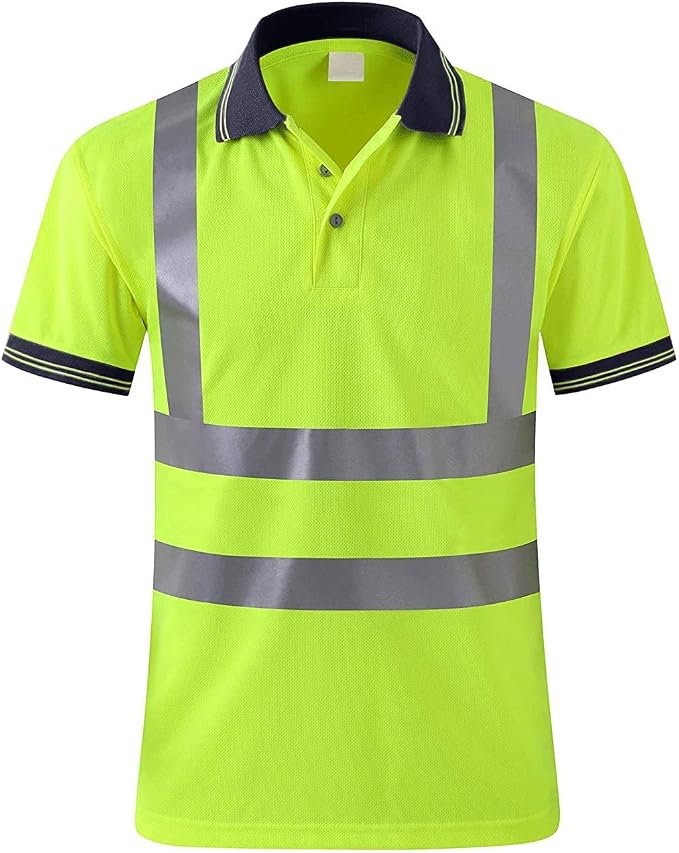
Hi Vis Polo Shirts: The Smart Choice for Safety, Comfort & Professional Workwear Introduction
ANSI/ISEA 107 vs EN ISO 20471: What's the Difference and Which Standard Do You Need?
Meta Title: ANSI 107 vs EN ISO 20471: Hi-Vis Standards Compared
Meta Description: Confused about ANSI/ISEA 107 vs EN ISO 20471? Learn the key differences in classes, reflective area, colors, and which standard your market requires.
If you are sourcing high visibility clothing for international markets, understanding the difference between ANSI 107 vs EN ISO 20471 is essential. These are the two dominant hi-vis standards in the world, and while they share a common goal — making workers visible — their class structures, material requirements, and testing methods differ in ways that directly affect what you can sell, where you can sell it, and how much it costs. This hi-vis standards comparison breaks down both certifications in detail and explains how to verify that your supplier meets the right one.
Why Hi-Vis Standards Exist
High visibility standards define the minimum design, performance, and labeling requirements for safety clothing intended to signal the wearer's presence visually in hazardous situations. Without a standard, buyers would have no objective way to compare products, and workers could be wearing garments that look bright but fail under real low-light conditions.
Both standards require garments to combine two types of material:
Background material: Highly colored fluorescent fabric intended for daylight visibility.
Retroreflective material: Tape or film that returns light from vehicle headlights to the source, providing nighttime visibility.
A combined-performance material that does both jobs simultaneously is also recognized by both standards. The differences begin with how much of each material is required and how performance is graded.
ANSI/ISEA 107: The North American Standard
The American National Standards Institute (ANSI) and the International Safety Equipment Association (ISEA) jointly publish ANSI/ISEA 107, the standard used in the United States and Canada. The current version is ANSI/ISEA 107-2020, which consolidated the older ANSI/ISEA 207 (public safety vests) into a single document.
Performance Classes
ANSI/ISEA 107 defines three performance classes based on the minimum area of visible material. Higher classes provide greater visibility and are intended for higher-risk environments.
Class 1: The lowest level, for workers in low-traffic environments where vehicle speeds do not exceed 25 mph (40 km/h). Requires a minimum of 0.14 m² (217 in²) of background material and 0.015 m² (23 in²) of reflective material.
Class 2: The most common class, for construction, warehousing, surveying, and delivery workers in moderate-traffic environments. Requires 0.50 m² (775 in²) of background material and 0.015 m² (23 in²) of reflective material.
Class 3: The highest level, for roadway workers, emergency responders, and anyone near traffic exceeding 50 mph (80 km/h). Requires 0.80 m² (1240 in²) of background material and 0.020 m² (31 in²) of reflective material, with full coverage on sleeves and legs (or trouser equivalents).
Type Designations
ANSI/ISEA 107-2020 also categorizes garments by "Type" based on the exposure scenario:
Type O (Off-Road): For occupational workers not exposed to roadway traffic (Class 1 only).
Type R (Roadway): For workers exposed to roadway traffic (Class 2 or 3).
Type P (Public Safety): For emergency responders, law enforcement, and incident command (Class 2 or 3, with optional breakaway features and color flexibility).
EN ISO 20471: The European and International Standard
EN ISO 20471 is published by the International Organization for Standardization (ISO) and adopted as a European Norm (EN). It is recognized across the European Union, the UK, the Middle East, parts of Asia, and many other regions. The current version is EN ISO 20471:2013+A1:2016.
Performance Classes
Like ANSI, EN ISO 20471 uses three classes, but the minimum material areas — especially for reflective tape — are substantially higher.
Class 1: Minimum risk level. Requires 0.14 m² of background material and 0.10 m² of reflective material. Intended for private grounds, warehouses, and low-speed environments.
Class 2: Intermediate level. Requires 0.50 m² of background material and 0.13 m² of reflective material. For road construction, logistics, and delivery personnel.
Class 3: Highest level. Requires 0.80 m² of background material and 0.20 m² of reflective material. For motorway, railway, and airport workers. The garment must cover the torso and have reflective bands on both sleeves and legs.
Critical Difference
EN ISO 20471 requires significantly more reflective material than ANSI/ISEA 107. At Class 2, EN ISO requires 0.13 m² of reflective tape versus only 0.015 m² under ANSI — nearly 9× more. A garment certified to ANSI Class 2 is very unlikely to meet EN ISO Class 2.
Side-by-Side Comparison
ANSI/ISEA 107 vs EN ISO 20471 — key requirements
Requirement ANSI/ISEA 107 EN ISO 20471
Primary region USA, Canada EU, UK, Middle East, Asia, global
Current version 107-2020 20471:2013+A1:2016
Background colors Yellow-green, orange-red, red Yellow, orange-red, red
Class 1 background 0.14 m² 0.14 m²
Class 2 background 0.50 m² 0.50 m²
Class 3 background 0.80 m² 0.80 m²
Class 1 reflective 0.015 m² 0.10 m²
Class 2 reflective 0.015 m² 0.13 m²
Class 3 reflective 0.020 m² 0.20 m²
Reflective band width No minimum width specified Minimum 50 mm (2 in)
Type designations Type O, R, P None (class only)
Sleeve/leg requirement (Class 3) Sleeves and/or trousers required Reflective on both arms and legs
Retroreflection test After 0, 5, 10, 20 wash cycles After 0, 5, 10 wash cycles (varies by care label)
Colorfastness Minimum grade 4 (color change), grade 3 (staining) Minimum grade 4 (color change), grade 3 (staining)
Color Requirements: Subtle but Important
Both standards specify chromaticity coordinates that define exactly what qualifies as fluorescent yellow, orange-red, or red. The coordinates are measured using a spectrophotometer under a D65 daylight illuminant. The practical difference for buyers is that ANSI recognizes "fluorescent yellow-green" while EN ISO uses the term "fluorescent yellow" — the color gamuts are similar but not identical. A fabric that passes ANSI yellow-green may sit slightly outside the EN ISO yellow gamut, and vice versa.
If you are sourcing a dual-certified garment, your manufacturer must use a fabric that satisfies both sets of chromaticity coordinates simultaneously. This is one of the most common reasons a garment passes one standard but fails the other.
Testing Methods and Durability
Both standards test for retroreflective performance using a standardized geometry, but the number of wash cycles and abrasion tests differ:
ANSI/ISEA 107 tests retroreflection after 0, 5, 10, and 20 washes (or after the maximum number of cycles indicated on the care label, whichever is lower).
EN ISO 20471 tests after 0, 5, and 10 washes, but also requires separate testing for temperature folding, rainfall exposure, and abrasion of the reflective surface.
EN ISO also mandates a minimum reflective tape width of 50 mm (2 inches), while ANSI does not specify a minimum width as long as the total area requirement is met. This means narrow segmented tapes that are popular in ANSI garments may not be acceptable for EN ISO-certified products.
Which Standard Do You Need?
The answer depends almost entirely on where the garments will be sold and used.
Standard selection by market and industry
Market / Industry Required Standard Typical Class
USA — construction, logistics ANSI/ISEA 107 Type R Class 2
USA — roadway, emergency ANSI/ISEA 107 Type R or P Class 3
Canada CSA Z96 (closely aligned with ANSI) Class 2 or 3
EU / UK — construction EN ISO 20471 Class 2
EU / UK — motorway, railway EN ISO 20471 Class 3
Middle East (GCC) EN ISO 20471 (widely adopted) Class 2 or 3
Australia / New Zealand AS/NZS 4602.1 (day/night) Class D/N
Selling globally Dual-certified to both standards Class 2 or 3
How to Verify Supplier Compliance
Claiming compliance is easy. Proving it requires documentation. When evaluating a manufacturer, ask for the following before placing an order:
EU Type-Examination Certificate (for EN ISO 20471): Issued by a Notified Body such as SGS, TÜV, Bureau Veritas, or Intertek. The certificate must list the exact product reference, the standard version, and the class.
Third-party test report (for ANSI/ISEA 107): An ISO 17025-accredited laboratory must conduct the tests. The report should cover color, retroreflection, and wash durability.
Declaration of Conformity (DoC): The manufacturer's signed declaration that the product meets the relevant regulation (e.g., EU Regulation 2016/425 for PPE).
Sample verification: Order a physical sample and inspect the labeling. EN ISO 20471 garments must carry the CE mark, the Notified Body number, the standard number, the class, and the care instructions. ANSI garments must display the ANSI/ISEA 107 designation, class, type, and manufacturer identification.
Why Dual Certification Matters
If you sell into both North American and European markets, sourcing dual-certified garments reduces your SKU count, simplifies inventory, and lowers production costs. A dual-certified hi-vis vest must meet the stricter of the two standards at every dimension — which generally means using EN ISO-compliant reflective area (0.10–0.20 m²) and a fabric that satisfies both color gamuts. ZHONGYU Garment produces dual-certified hi-vis workwear that meets both CE EN ISO 20471 and ANSI/ISEA 107 requirements, with full third-party documentation available on request.
Common Mistakes to Avoid
Assuming "hi-vis" equals "certified": Bright orange fabric alone does not meet any standard unless it passes chromaticity testing and is combined with the required reflective area.
Mixing class levels: A Class 2 vest worn over non-certified trousers does not create a Class 3 ensemble unless the trousers also carry certification.
Ignoring the care label: Certification is only valid if the garment is maintained according to the tested wash instructions. Home bleaching or dry cleaning can invalidate compliance.
Overlooking logo placement: Printing a large logo over reflective tape or background material can reduce the certified area below the minimum threshold.